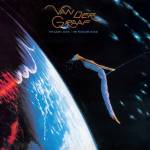
Yuriy P. - 10/Jun/2025  Many bands can be considered the founders of classic art rock, and it is not entirely deserved that they often talk about King Crimson, Genesis and Yes and forget to mention the no less remarkable team - Van Der Graaf Generator and its leader - Peter Hammill, and they released their first art rock album before all the above-mentioned bands. Dramatic vocals with incredible modulations, which some people just need to get used to (though I liked it right away), virtuoso keyboards, a saxophone that produces absolutely incredible sounds (sometimes reminiscent of a hard guitar), an inventive rhythm section, dark melodies, lyrics on apocalyptic and sci-fi themes - these are the distinctive features of this group, formed at the University of Manchester in 1968. They took the name in honor of the high-voltage generator invented by the American physicist Van de Graaf. The band's third album has a rather strange title, which can be translated roughly as "The reaction of hydrogen to helium in me, who is the only one." The mentioned chemical reaction is the main source of energy in the Universe, and the second part of the phrase implies that the lyrical hero has no pair with whom he could be one. This album is one of the band's strongest works, and the theme of loneliness that runs through the entire album allows us to consider it a conceptual work. 1) "Killer". With a slow organ-guitar intro under a rather harsh saxophone, we meet a killer fish that has destroyed and scared away all its fellows and is ultimately left alone. The chorus is faster and more emotional. The middle passage is at the same tempo, during which a very aggressive saxophone sounds. At the end, Hammill compares himself to this killer, saying that he is the same, since he also killed the love in himself and is now alone. The ending repeats the phrase “We need love” several times, as if calling on all listeners.
2) “House with No Door”. A great composition, mostly based on piano. There is a wonderful flute solo. Towards the end, the theme speeds up. The song is about a man living in a house without a door, a roof, a bell, without any sounds or light. He has built walls around himself, through which love cannot penetrate, although he longs for it. A very image-rich theme about loneliness and the desire to have someone by your side.
3) “The Emperor in His War-Room”. A sad 2-part composition with excellent organ and flute. In the 1st part (The Emperor), sometimes lyrical, sometimes harsh, we meet a warlike emperor who has destroyed everyone around him. Part 2 (The Room) – the music speeds up and there is either a great guitar solo (performed by “guest” Robert Fripp) or a saxophone. Addressing the emperor, the lyrical hero says that instead of power, he will eventually find death, and this really happens – justice has prevailed, and someone kills the bloodthirsty ruler with a dagger.
4) “Lost”. Another 2-part piece. Here, the influence of jazz is most noticeable. In the 1st part (The Dance in Sand and Sea), quite fast and falsely major, the hero of the song remembers the past, when he felt good with his beloved, when they danced together, but now everything has changed – she is far away, and he is alone. Part 2 (The Dance in the Frost) is tougher (with a hard saxophone), and then lyrical; in it, the hero says that he feels like he is dead, he still loves and would really like to find the words that would convince his chosen one of this. He could try to forget, but it doesn’t work. “I love you,” he cries through his tears.
5) “Pioneers over c.” A slow, gloomy sci-fi composition that begins with a jam in the spirit of early Pink Floyd. It tells the story of a flight to distant stars. The title is a play on words: it sounds similar to “Pioneers Oversea,” but here the c. stands for the speed of light that these astronauts are the first to overcome. The hero of the song understands that a monument will be erected to him and his comrades for their feat, and perhaps they already have, several centuries ago. But what does it matter to him? They found themselves in a completely incomprehensible world, became ghosts in the void, from which they can no longer return to normal life, because they no longer have a corporeal shell. In the end, the hero is left alone, “the one who went into space, or stayed in place, or did not exist at all.” By the way, the album cover clearly refers to the latter composition, since it depicts what might be the hands of God trying to cope with the mechanism of the Universe. Or perhaps these are the hands of a man who has the same intentions.
|



 Pop International
353.344
- Asia Pop 9.595- Austro Pop 227- Brit Pop 280- Dutch Pop 9- Euro Pop 50- French Pop 680- Indie Pop/Lo Fi 23- Italo Pop 334- Latin Pop 7.125- MiddleoftheRoad 3.077- Oldies 60- Other Pop 331.237- Party 44- Synthi Pop 292- The 60s 311
Pop International
353.344
- Asia Pop 9.595- Austro Pop 227- Brit Pop 280- Dutch Pop 9- Euro Pop 50- French Pop 680- Indie Pop/Lo Fi 23- Italo Pop 334- Latin Pop 7.125- MiddleoftheRoad 3.077- Oldies 60- Other Pop 331.237- Party 44- Synthi Pop 292- The 60s 311



![phil Collins - No Jacket Required(2025 Mix) [DE-Version, Regio 2/B]](https://www.playthek.co.uk/images/superd/063/781/1uakqp1x.j11)