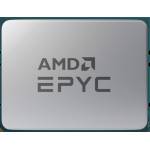
The EPYC 4124P by AMD is a server-grade processor designed for demanding, multi-threaded workloads in modern data centers and professional environments. With a base clock of 3.8 GHz, 4 physical cores and 8 threads as well as a 16 MB cache, it delivers strong single- and multi-core performance for a wide range of applications. The AM5 socket ensures compatibility with current server and workstation platforms in the AMD ecosystem, offering a modern foundation for powerful and energy-efficient systems. Delivered as an OEM version (100-000001570), this CPU is particularly suitable for system integrators, IT departments and professional users who assemble customized solutions.
From a technical perspective, the 3.8 GHz clock frequency provides excellent responsiveness for latency-sensitive services such as web servers, smaller databases, virtualized environments with limited VM density, edge computing nodes or specialized appliances like firewalls and storage controllers. The 4 cores and 8 threads enable efficient parallel processing of multiple tasks, so that several services or lightweight containers can be run simultaneously without significant performance loss. The 16 MB cache reduces memory access latency and improves throughput in typical server workloads, as frequently used data and instructions are kept closer to the cores. Combined with the AM5 platform, this allows the use of fast memory and modern I/O options, helping to build flexible systems with high data transfer rates and low latencies.
In practical use, the EPYC 4124P is suitable for compact servers, small to medium business infrastructures, branch office servers, virtualization hosts with limited user numbers, development and test environments, as well as specialized industry and edge solutions. It is ideal where reliability and consistent performance are more important than extreme core counts: for example, for hosting web applications, running collaboration tools, handling moderate database workloads, managing company-internal file and print services, or providing infrastructure services such as DNS, DHCP and directory services. Thanks to its multi-threading and efficient architecture, the processor can also serve as the heart of scalable microservice architectures, container clusters or CI/CD pipelines that require stable performance and high availability.
The advantages of this product include an attractive balance of performance, efficiency and platform modernity. The relatively high base frequency benefits applications that cannot scale across many cores but demand high per-core performance. At the same time, the multi-threading capability improves overall utilization and offers reserves for parallel workloads. As part of the EPYC family, the CPU inherits AMD's focus on security and manageability at platform level, making it a robust foundation for professional IT environments. The OEM variant allows system builders to integrate the CPU directly into customized server or workstation designs, optimize cooling and housing concepts, and thus create tailored solutions that fit exactly to the intended use.
AMD as a manufacturer has established itself as an innovative force in the processor market, particularly in the areas of multi-core architectures and energy efficiency. The company continuously works on improving performance per watt and making computing more efficient overall. While specific sustainability measures for this exact CPU model are not publicly detailed, AMD in general pursues goals such as reducing the energy consumption of its products and enabling more efficient data centers. By relying on modern manufacturing processes and architectural optimizations, AMD processors help to lower the power requirements per unit of computing power, which can contribute to reduced operating costs and a smaller environmental footprint. Customers who choose a contemporary, efficiency-focused server CPU like the EPYC 4124P can thus not only modernize their IT infrastructure, but also contribute to more responsible use of resources by consolidating workloads and reducing the number of required systems.



 PC-Components
28.286
- CPU Processors 474- Computer Cases 3.998- External Optical Dr. 139- Fans&Cooling 2.895- Graphics Cards 516- Internal Optical Dr. 66- Motherboards 794- PC Adapters 2.778- PC Cables 9.346- Port Cards&Controll. 365- Power Supplies 4.225- RAM Memory Laptop 300- RAM Memory PC 2.023- Sound cards 20- more Components 347Scanner 590Servers&Accessories 7.041Tablets 1.835
PC-Components
28.286
- CPU Processors 474- Computer Cases 3.998- External Optical Dr. 139- Fans&Cooling 2.895- Graphics Cards 516- Internal Optical Dr. 66- Motherboards 794- PC Adapters 2.778- PC Cables 9.346- Port Cards&Controll. 365- Power Supplies 4.225- RAM Memory Laptop 300- RAM Memory PC 2.023- Sound cards 20- more Components 347Scanner 590Servers&Accessories 7.041Tablets 1.835


![Amd - AMD Ryzen 7 9800X3D processor 4.7 GHz 96 MB L3 Tray [Tray]](https://www.playthek.co.uk/images/icecatdaten/592/660/08592978592660k.jpg)
![Amd - AMD Ryzen 7 9800X3D processor 4.7 GHz 96 MB L3 Tray [Tray]](https://www.playthek.co.uk/images/icecatdaten/819/305/04251538819305Low2.jpg)
![Amd - AMD Ryzen 7 9850X3D processor 4.7 GHz 96 MB L3 Tray [Tray]](https://www.playthek.co.uk/images/icecatdaten/820/615/04251538820615k.jpg)





![Amd - AMD Ryzen Threadripper PRO 7965WX processor 4.2 GHz 128 MB L3 Tray [Tray]](https://www.playthek.co.uk/images/icecatdaten/519/780/08592978519780k.jpg)
